GEO vs SEO: Does Ranking on Google Still Get You Cited by AI?
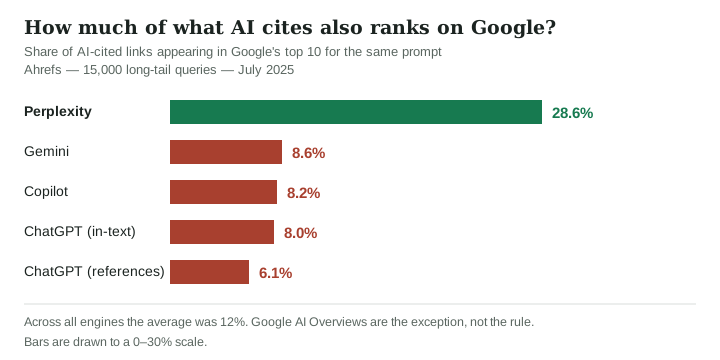
Ranking on Google still helps, but far less than the industry assumes, and the amount it helps depends almost entirely on which engine you mean. Ahrefs analysed 15,000 long-tail queries and found that only 12% of the links cited by ChatGPT, Gemini and Copilot also appeared in Google’s top 10 for the same prompt. Perplexity was the closest to classic search at 28.6%. ChatGPT was the furthest away at 6–8%. So GEO is not a rebrand of SEO, and it is not a separate discipline either. The foundations transfer completely; the ranking work transfers weakly, and it is transferring less every quarter.
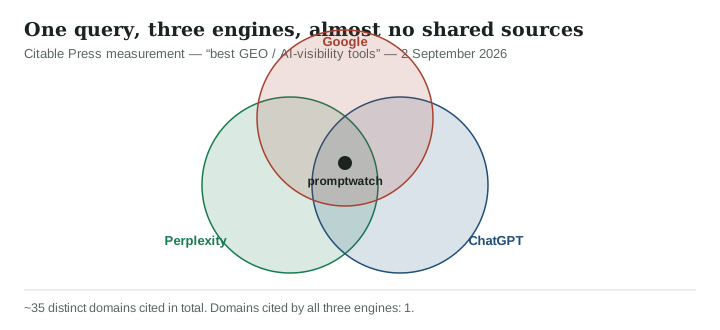
Our own measurement, and it lines up. On 2 September 2026 we put one identical buyer-intent query — “best GEO / AI-visibility tools” — to Google, Perplexity and ChatGPT on the same day, and logged every domain each engine cited. Between them they cited roughly 35 distinct domains. Google and Perplexity shared three. Google and ChatGPT shared one. That single query, with a sample size of one, reproduced the exact rank ordering Ahrefs found across 15,000: Perplexity sits closest to Google’s results, and ChatGPT sits furthest from them. When a one-query spot check and a 15,000-query study agree on the ordering, the ordering is probably real.
Key Takeaways
- 12% of AI-cited links rank in Google’s top 10 for the same prompt (Ahrefs, 15,000 queries, July 2025).
- The spread by engine is enormous: Perplexity 28.6%, ChatGPT 6–8%. “Get cited by AI” is not one target.
- Inside Google’s own AI Overviews the link is stronger but weakening fast — 76% down to 38% in eight months.
- Almost 90% of pages ChatGPT cites rank position 21 or lower in classic search (Semrush).
- A citation is not a click: when an AI summary appears, 1% of visits click a cited source (Pew Research Center).
GEO and SEO, Defined
Four terms do most of the work in this piece, so here they are up front.
SEO is the craft of getting a page to rank high in a list of blue links. The unit of work is the page. The payoff is a click.
GEO is the craft of getting a passage quoted inside a generated answer. The unit of work is the passage. The payoff is often a citation with no click at all.
Query fan-out is the habit engines have of splitting your question into several smaller ones, then hunting sources for each. It means the engine rarely searches the words you typed.
Extraction is the step where a model lifts a claim out of your page to use in its answer. A page can rank well and still be hard to lift from.
That last pair is the whole argument in miniature. Ranking and being quoted are two different tests, and a page can pass one while failing the other.
Does Ranking on Google Get You Cited by AI?
The question has a number attached to it, which is unusual in this field and worth using.
In July 2025 Ahrefs ran 15,000 long-tail queries through ChatGPT, Gemini, Copilot and Perplexity, and checked every cited link against Google’s top 10 for that same prompt. The average overlap was 12%. Roughly seven in eight things an AI assistant cites are not on Google’s first page for the question the user actually asked.
Semrush reached the same place from the other direction. Studying over 500 marketing and SEO topics, it found that the pages ChatGPT cites rank in classic search positions 21 or lower almost 90% of the time. Two independent teams, two methods, one conclusion: for AI assistants, page-one rank is a weak predictor of citation.
Why the Answer Differs So Much by Engine
The averages hide the useful part. Here is the same study broken out.
| Surface | AI-cited links also in Google’s top 10 | What that implies |
|---|---|---|
| Google AI Overviews | 38% (March 2026), down from 76% | Rank still matters most here, and is fading |
| Perplexity | 28.6% | Closest to classic SEO; cites broadly and often |
| Gemini | 8.6% | Google’s assistant, but not Google’s index behaviour |
| Copilot | 8.2% | 16.6% overlap with Bing’s top 10 instead |
| ChatGPT (in-text) | 8.0% | Effectively its own retrieval world |
| ChatGPT (references) | 6.1% | The hardest surface to reach through rank |
Consider what that table means for a strategy document that says “we will improve AI visibility.” Improving AI Overview visibility is largely classic SEO. Improving ChatGPT visibility is largely not. Those are two projects with different tactics, different timelines and different success measures, and merging them into one line item is how budgets get spent on the wrong work.
Our own measurement, small as it is, showed the same shape. Perplexity cited more than twenty domains on a single query, including several very low-authority ones. ChatGPT cited seven, of which six appeared nowhere in Google’s results. For example, if your realistic goal this quarter is a first AI citation of any kind, Perplexity is the honest target — it cites broadly enough that good work can actually surface there.
Even Inside Google, Rank Is Losing Its Grip
Google AI Overviews are the strongest remaining case for “just do SEO,” and that case is falling in public.
In July 2025, Ahrefs found 76% of AI Overview citations came from pages in Google’s own top 10. By March 2026, repeating the analysis across 863,000 keywords and 4 million AI Overview URLs, the figure was 38%. It halved in eight months.
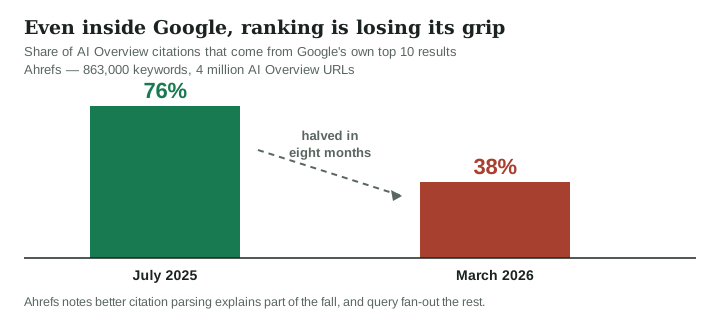
Two caveats belong with that number, and Ahrefs raised both itself. Its citation parsing improved between the two studies, so it now detects citations it previously missed. And Google’s query fan-out — splitting one question into several sub-queries before choosing sources — means the “top 10” being compared against is increasingly the wrong list. The AI Overview is not answering the query you typed. It is answering four queries it invented.
That second point is the more useful one, because it generalises. Every engine here does some version of fan-out. Tuning a page for the exact phrase a user types is tuning for a question the machine will break up before it looks for sources.
What Actually Transfers
Strip out the ranking layer and a lot survives intact. These carry over completely, because they are the price of entry to any retrieval system, not features of one:
- Crawl access. Nothing can cite a page it cannot fetch. Blocking GPTBot or ClaudeBot in
robots.txtremoves you from the running entirely, and plenty of sites have done it by accident. - Indexation and clean architecture. Server-rendered HTML, sane internal linking, no critical content locked behind client-side rendering.
- Entity clarity. Saying plainly what your organisation is, what it does, and what it is not. Retrieval systems work out who you are before they pick a passage.
- Topical depth. Covering a subject properly still beats covering it thinly, on both surfaces, for the same underlying reason.
- Page speed and mobile rendering, in the ordinary way, as hygiene rather than as a lever.
None of that is new work. If you have been doing SEO competently, you have already done it, and it is worth saying clearly because the GEO discourse has an interest in implying otherwise.
What Doesn’t Transfer
- Position obsession. Moving from #6 to #3 is a real SEO win and close to a non-event for ChatGPT citation, where roughly nine in ten cited pages rank 21 or lower anyway.
- The page as the unit of work. Search ranks pages; generative engines extract passages. A page can rank well and still contain nothing quotable — no self-contained claim, no figure with a source, nothing a model can lift without inheriting your ambiguity.
- The click as the outcome. More on this below. It is the biggest change, and the least discussed.
- Single-target thinking. One ranked list has been replaced by several retrieval systems that agree with each other far less than anyone expected.
The deepest change is what counts as a result. SEO’s unit is a ranked page and its payoff is a click. GEO’s unit is an extractable passage and its payoff is frequently no click at all — your claim gets stated in the answer, sourced to you, and the user never arrives. Pew Research tracked 68,879 Google searches from 900 US adults in March 2025 and found that when an AI summary appeared, 1% of visits produced a click on a source cited inside it. Click-through on ordinary results fell from 15% to 8% on the same pages. So the honest way to describe a citation is as brand credit, not as traffic. Any GEO plan measured purely in sessions will look like a failure while it is working.
What Is Genuinely New
Three things, and only three, are actually new work rather than renamed old work.
Passage-level engineering. The most rigorous published attempt to measure this is GEO: Generative Engine Optimization (Aggarwal et al., accepted to KDD 2024), which built a benchmark of generative-engine queries and tested content-level edits against it. Adding citations, adding quotations from credible sources and adding statistics boosted visibility in generative responses by up to 40%. Those are page-level edits with a measured effect size, which is more than most of what gets sold as GEO can claim — including llms.txt, which on current evidence is read by almost nothing.
Per-engine measurement. Because the engines overlap so little, one visibility number is meaningless. You need per-engine tracking, and you need to name which engine your goal refers to before you set the goal. We had to do exactly this to our own plan after the measurement above, which is documented in our methodology.
Economics that run backwards. Fewer visits, worth more each. Semrush measured AI-search visitors converting at 4.4 times the rate of traditional organic visitors, on the logic that someone arriving after an AI answer has already been sold. Combine that with Pew’s 1% click rate and the shape is clear: AI search is a low-volume, high-intent channel, and reporting it against SEO’s volume benchmarks will make a working channel look broken.
So What Should You Actually Do?
| Your situation | What to prioritise | Why |
|---|---|---|
| Strong Google rankings, no AI citations | Passage structure, not more link building | You already pass the crawl and index bar; you fail the extraction bar |
| No rankings anywhere | Classic SEO first | Everything downstream needs crawl access and indexing |
| Targeting AI Overviews specifically | Classic SEO, still | 38% of citations come from the top 10 — much the highest of any surface |
| Targeting ChatGPT specifically | Quotable claims, cited figures, entity clarity | Rank explains almost none of its citation behaviour |
| Want a first citation this quarter | Aim at Perplexity | It cites broadly, including low-authority domains |
| Reporting to a client or a boss | Report per engine, and never in sessions alone | One blended number hides everything that matters |
How We Checked This
Every figure here is tied to a named study with a date and a sample size, and each was read at source rather than picked up from a summary. Where a study raises doubts about its own numbers, we pass those on — the Ahrefs caveat about parsing is the clearest case. Our editorial standard is simple: a claim with no dated source does not go in. The full version is on our methodology page.
The Bottom Line
GEO is not SEO’s replacement and it is not SEO’s sequel. It is a second, partly-overlapping game played on the same board, and the overlap is smaller than the industry sells and shrinking. Keep every technical foundation you built — those are load-bearing on both. Stop treating position as the goal, start treating the extractable passage as the unit of work, and measure each engine separately, because on the evidence they barely agree on anything.
For the practical version of that — the specific page-level changes with evidence behind them — start with how to get cited by AI search. For a worked example of a popular tactic that does not survive contact with the data, see our piece on llms.txt.