Best AI-Visibility Tools in 2026: What to Buy, and What's Free
Some links on this page are affiliate links. If you buy through them we may earn a commission at no extra cost to you. We only link tools we have actually evaluated.

Disclosure: some links in this article are affiliate links. If you buy through one, we may earn a commission at no extra cost to you. It does not change what we recommend, and the main recommendation in this piece is to spend nothing.
For most sites the honest answer is now: buy nothing yet. On 31 August 2026 Google finished rolling out its Generative AI performance report to every property in Search Console, which means free impression data for AI Overviews and AI Mode. That covers the surface where conventional ranking still matters most. Paid tools earn their money on a narrower job: watching ChatGPT and Perplexity, where Google cannot see and will not tell you. If you do not yet know whether you appear in those, a spreadsheet and twenty minutes will tell you for £0 — and that is where this guide starts.
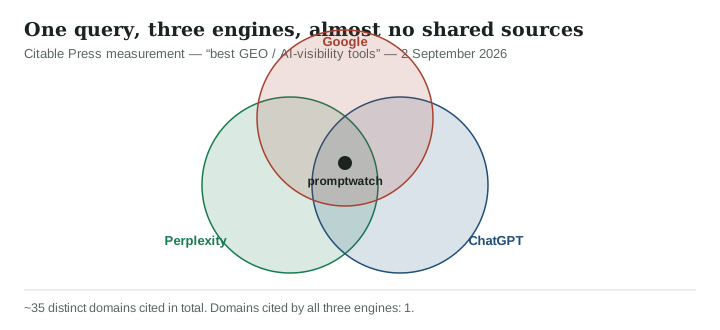
We ran the free method on ourselves first. On 2 September 2026 we put one identical buyer-intent query to Google, Perplexity and ChatGPT on the same day and logged every domain each engine cited. It took under half an hour and cost nothing. Between them the three engines cited roughly 35 distinct domains, and exactly one appeared on all three. No tool sold us that. It also reframed the buying question: a product that reports “your AI visibility” as a single number is averaging three systems that agree on almost nothing.
Key Takeaways
- Search Console’s Generative AI report reached all sites on 31 August 2026. Impressions only — no clicks, no CTR, no position.
- The cheapest real tracker is Otterly Lite at $29/month for 15 prompts across four engines.
- Profound starts at $99/month on annual billing, but that tier watches ChatGPT only; three engines costs $399/month.
- Peec AI publishes no monthly price at all — annual billing only, which tells you who it is sold to.
- Every price below was read at the vendor’s own page on 4 September 2026, not copied from a review.
What an AI-Visibility Tool Actually Is
Four terms cover almost everything these products sell.
An AI-visibility tool is software that asks AI engines a fixed list of questions on a schedule and records whether you were mentioned or cited. That is the core of it. Everything else is presentation.
Prompt tracking is the unit you are billed in. A prompt is one question checked on a schedule, so 15 prompts means 15 questions, not 15 keywords in the SEO sense.
Share of voice is how often you appear across a prompt set compared with named competitors. It is the metric most agencies report, and it is only as good as the prompt list behind it.
Agent analytics is server-side logging of AI crawlers and agents hitting your site. It answers a different question — who is fetching you — rather than who is citing you.
Note what none of that includes. No tool can tell you why an engine cited someone. They measure the outcome, and the causes remain a matter of inference.
The Free Stack, Which Just Got Better
| Tool | Cost | What it gives you | The catch |
|---|---|---|---|
| Search Console — Generative AI report | Free | Impressions in AI Overviews and AI Mode | Impressions only; Google surfaces only |
| Search Console — standard reports | Free | Clicks, CTR, position for web search | AI surfaces not broken out here |
| GA4 with a custom channel group | Free | Sessions referred by ChatGPT, Perplexity and others | Referral data only; many AI visits arrive with no referrer |
| Bing Webmaster Tools | Free | The index behind Copilot | Copilot-shaped, not ChatGPT-shaped |
| A spreadsheet and a fixed prompt list | Free | Actual citations, per engine, in your own words | Manual, and you must be honest about sample size |
The last row is the one people skip, and it is the one that taught us the most. Consider what it costs to run: pick ten questions a buyer would really ask, put each to ChatGPT, Perplexity and Google on the same day, and record which domains get cited. Repeat monthly. That is a half-hour a month and it produces per-engine data most $200 dashboards will not give you, because you chose the questions.
The honest limit is sample size. Ten prompts checked by hand once a month is a smaller, noisier sample than a tool checking a hundred daily, and personalisation can skew a logged-in account. Say so in your reporting and the method holds up fine.
What the Paid Tools Cost
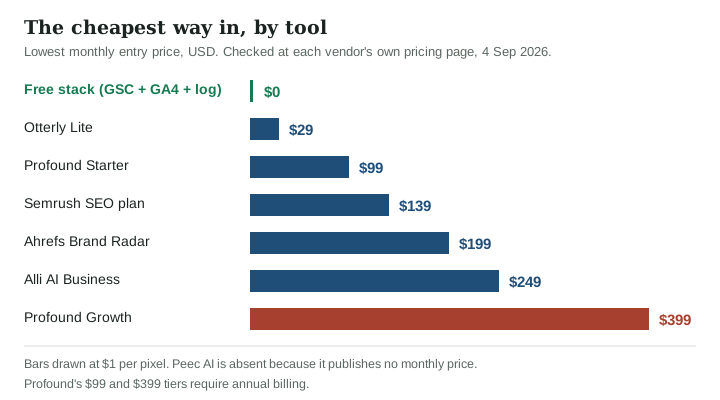
Every figure here was read at the vendor’s own pricing page on 4 September 2026. This market re-prices often, so treat the date as part of the number.
| Tool | Entry price | What you get at that price | Engines |
|---|---|---|---|
| Otterly.AI | $29/mo (Lite) | 15 prompts, daily checks, unlimited seats | ChatGPT, AI Overviews, Perplexity, Copilot |
| Otterly.AI | $189/mo (Standard) | 100 prompts, API and MCP access, agent analytics | Same four |
| Profound | $99/mo (Starter, annual) | 50 prompts, 100 agent credits | ChatGPT only |
| Profound | $399/mo (Growth, annual) | 100 prompts, 400 agent credits | 3 engines |
| Semrush | $139/mo (SEO plan, monthly) | Full SEO suite; AI Visibility features included | Multiple |
| Ahrefs Brand Radar | $199/mo standalone | Brand and AI mention tracking | Multiple |
| Alli AI | $249/mo (Business) | 5 sites, 500 keywords, pre-rendering for AI crawlers | Crawler-side, not prompt-side |
| Peec AI | No public monthly price | 50 prompts at Starter, annual billing | Up to 12 models at Enterprise |
Three things in that table are worth more than the prices themselves.
Profound’s $99 tier watches ChatGPT only. Given that the three big engines share almost no citations, single-engine tracking at $99 a month is a partial view sold at a full-view price. The three-engine tier is four times more.
Peec AI publishes no monthly price. Annual billing only, with a sales conversation for anything above Advanced. That is a signal about who the product is for, and it is a fair signal to act on if you are a small team.
Semrush includes AI visibility rather than charging separately for it. Its pricing page on 4 September 2026 lists AI Visibility features across the paid plans and on the free account. Several review sites still describe a $99-a-month add-on, which is the sort of stale figure that survives because nobody re-checks. If you already pay for Semrush, check what you are entitled to before buying anything else — see current Semrush plans
A Warning About Every Other Guide to This
While researching this piece we ran the obvious query — the same one from our own measurement — and read what ranked. Nearly every result was a review of AI-visibility tools published by a competing AI-visibility tool. Vendor blogs reviewing rivals, ranked for the exact query a buyer types.
That is not a scandal, and it is not illegal. It is simply a market where the reviews are written by the sellers. Read accordingly, check prices at the vendor, and notice when a “best tools” list happens to place the publisher’s own product first. We sell no tool, we take affiliate commission on two of the products above, and we have told you which — that is the arrangement, stated plainly, and our methodology page explains how we handle it.
Who Should Actually Buy Something
| If you are… | Buy | Why |
|---|---|---|
| A solo site or small business | Nothing yet | Search Console’s free report plus a monthly manual check covers you |
| Curious whether you appear in ChatGPT at all | Otterly Lite, $29 | Cheapest real per-engine tracking; cancel after two months if flat |
| Already paying for Semrush | Nothing extra | AI Visibility features are in the plans you already have |
| An agency reporting to clients | Otterly Standard or Profound Growth | You are buying reporting and API access, not insight |
| Fixing crawler access at scale | Alli AI | It solves a different problem: being fetchable, not being cited |
| An enterprise with a procurement process | Profound or Peec | Priced and built for that buyer, and they know it |
For example, a consultancy with six clients and no tracking should start at Otterly Standard, because $189 across six accounts is cheap reporting. A one-person business selling locally should start with a spreadsheet, because the answer will probably be “you are not cited anywhere yet”, and no tool improves that answer.
What No Tool Will Fix
Visibility software is a thermometer. It does not change the temperature.
The only published work with a measured effect on generative-engine visibility is content-level: GEO: Generative Engine Optimization (Aggarwal et al., accepted to KDD 2024) found that adding citations, quotations from credible sources and statistics lifted visibility in generative responses by up to 40%. Those are edits to your pages. No dashboard makes them for you, and our guide to getting cited covers the ones with evidence behind them.
It is also worth being clear about what a citation is worth. Pew Research Center tracked 68,879 Google searches across 900 US adults and found that when an AI summary appeared, 1% of visits produced a click on a source cited inside it. A tool that charges $399 a month to count citations is counting something real, and mostly not counting traffic. Price the subscription against brand exposure, not against sessions, or it will always look like a bad deal.
How We Checked This
Every price here was read at the vendor’s own pricing page on 4 September 2026, and none was taken from a review site or a comparison table. Where a vendor publishes no monthly price, we say so rather than estimating. Where our figure disagrees with the prevailing write-ups, as with the Semrush add-on, we flag the disagreement instead of quietly picking one. Our editorial rule is that a number with no source and no date does not go in, and we will date-stamp corrections here rather than silently editing them.
The Bottom Line
The free tier of this market improved sharply on 31 August 2026, and most of the buying advice written before then is now wrong. Start with Search Console’s Generative AI report and a ten-prompt spreadsheet. Move to Otterly Lite at $29 when you need daily per-engine tracking. Go past that only when someone is paying you to produce reports, or when procurement requires a vendor.
And spend the money you saved on the pages themselves. On the evidence, that is the only part that changes the outcome — which is the argument of our piece on what actually transfers from SEO, and the reason we keep saying no to tactics like llms.txt that measure well as line items and do nothing.